

Facilitating confidence, independence, and autonomy
Intervenors are trained professionals that act as the “eyes and ears” of a person who is Deafblind, providing specialized communications services and supports. DBCS’s intervenor services aim to empower people who are Deafblind to live their lives with confidence, independence, and safety.
These critical services help ensure people who are Deafblind can access the information they need in a way that’s accessible to them. Intervenor services help to enable clients to make informed choices, plan future actions, communicate successfully, and navigate their environment.
Please note that these services are currently only available to people who are Deafblind in British Columbia, Ontario and Saskatchewan.
Request Intervenor Services
We’re here to help
If you or someone you care about needs our help, we're here.
If you or someone you love has experienced dual sensory loss, we can help. Whether you need support with communication, accessing parts of your community, our high quality, personalized services are here to a diverse set of needs.
Through our customized intervenor services, we aim to empower people who are Deafblind to live the lives they choose with confidence, independence, and safety.
Our intervenor services are available to Deafblind adults who are at least 18 years old and who live in Ontario, Saskatchewan and British Columbia.
*Clients in Northern Ontario can access services from the Canadian Hearing Services.


Ready to get started?
How to request intervenor services
Specialized support is just a few steps away.
1. Get it touch
- Send us an email at info@deafblindservices.ca or get in contact with your local regional manager by visiting the contact us page.
- You can expect to receive a response from a DBCS team member within two to three business days.
2. Eligibility Assessment
- Once we’ve had a chance to connect, we’ll conduct an eligibility assessment to ensure that we are able to provide the support you need.
- During the assessment, we’ll discuss how we will develop a customized service plan and agreement that will best support your personal needs.
3. Service Agreement
- The final step in the process involves completing your personalized service agreement. This agreement will outline the type of services you are eligible for, and the number of service hours you’ll have access to on a weekly basis.
Important note for residents of Ontario:
The Access Intervenor Service (AIS) is a new online portal that was launched to help people who are Deafblind to access services in an easier, more equitable way. On October 3, 2022, the AIS portal opened to allow a single point of access to services for people who are Deafblind looking to access service for the first time.
The system provides navigational supports for users to find services while ensuring that these supports and services are assessed uniformly across the province.
To learn more, or to access the AIS, visit AccessIntervenorServices.com
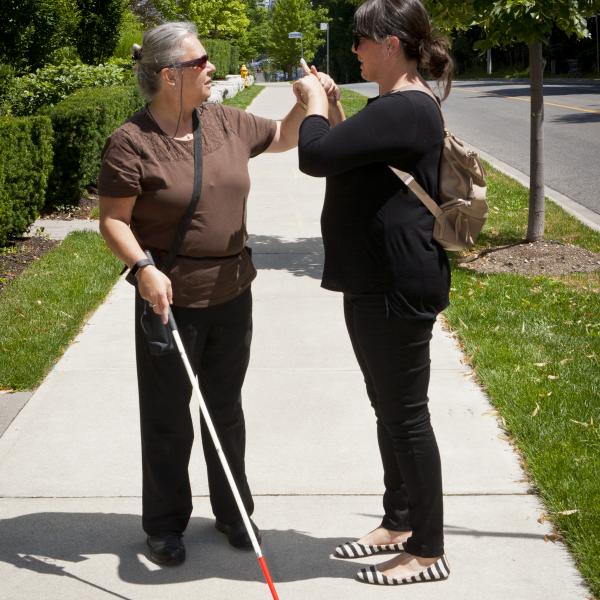
Facilitating communication, access and participation
Intervenors are trained professionals who help facilitate communication, access, and participation in all parts of daily life for people who are Deafblind. They are narrators, informers, guides, and communicators. Taking direction from the person who is Deafblind, intervenors help enable communication and provide information about the physical environment.
An intervenor communicates with a person who is Deafblind using a variety of communication methods, including American Sign Language (both visual and tactile), two-hand manual, voiceover, print-on-palm, large-print notes and more.
Intervenor services truly change lives by creating hope, building confidence, increasing safety and independence - leading the way to a brighter future, and opening up a world of possibilities for people who are Deafblind across Canada.
How do intervenors help?
Intervenors must always be ready and willing to adapt to each client’s individual needs and provide support in many different ways. Intervenor services can be used to assist adults who are Deafblind with:
- Facilitating communication. Similar to a translator, intervenors provide communication support for clients, enabling them to access their community (such as going to the bank, the library, shopping or attending a class).
- Access to information. Access to accurate and up-to-date information is critical, and enable individuals to make informed decisions, especially during important or sensitive meetings, such as medical appointments or during meetings with a lawyer.
- Building confidence in independent living skills. Intervenors can provide support in everyday skills that will enable independence in their daily lives, such as managing money, making purchases, using public transportation, taking medications, providing transportation and more.
- Day-to-day activities. From reading the mail to engaging in physical activity, to socializing with friends and family – intervenors help facilitate access to a wide variety of activities that enhance daily life – and offer clients the freedom to choose the lives they want to live.

The Deafblind community has a diverse population. Each person has varying degrees of combined vision and hearing loss, which means that each individual’s preferred communication is unique.
Certified Deafblind Intervenor Specialists (CDBIS)
CNIB Deafblind Community Services is proud to say that all our intervenors are currently working towards achieving CDBIS Certification.